
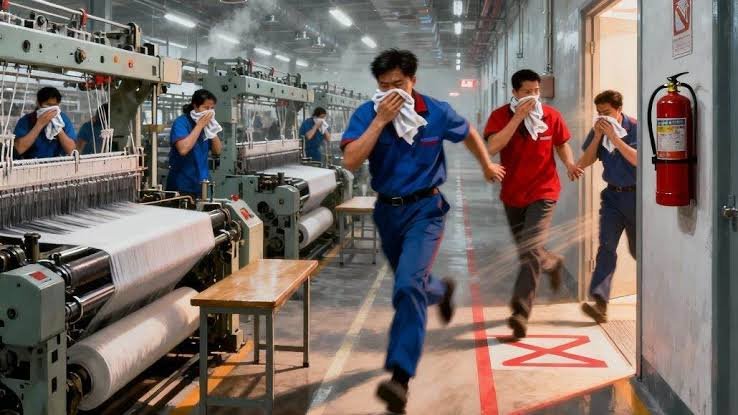
Textile mills are an important part of Pakistan’s industrial sector, providing employment and supporting the production of yarn, fabric, garments, and other textile products. At the same time, textile manufacturing can involve significant fire-safety challenges because many processes use combustible fibers, fabrics, packaging materials, electrical machinery, heat-producing equipment, and large production areas.
Fire safety in a textile mill is therefore more than simply keeping a few extinguishers near the entrance. Effective protection requires a combination of prevention, early detection, alarm systems, suppression equipment, emergency planning, employee awareness, and regular maintenance.
Pakistan’s Building Code Fire Safety Provisions 2016 addresses fire prevention, life safety, and fire protection for buildings and structures, and the Pakistan Engineering Council lists these provisions among its building codes and standards.
Here are five important reasons why textile mill fire safety deserves more attention.
1. Textile Materials Can Increase Fire Risk
The first reason is the amount and type of combustible material commonly found in textile facilities.
Cotton, fibers, yarn, fabric, paper packaging, cardboard, wooden pallets, and other materials may be present throughout different parts of a mill. Depending on the manufacturing process and storage conditions, these materials can contribute to the development of a fire.
Production areas may also contain machinery, motors, electrical equipment, belts, bearings, heating systems, and other components that require regular inspection and maintenance.
This means fire prevention should begin with identifying where combustible materials and potential ignition sources are located.
Good Housekeeping Matters
A clean and organized workplace can support fire prevention.
Textile mills should establish procedures for:
- Removing unnecessary waste and accumulated fibers
- Keeping machinery and surrounding areas clean
- Maintaining clear access to exits
- Storing materials appropriately
- Keeping combustible waste away from potential ignition sources
- Inspecting electrical equipment regularly
- Maintaining machinery according to manufacturer recommendations
Good housekeeping does not replace a fire-protection system, but it can reduce avoidable risks and make emergency response easier.
2. Early Detection Can Make a Major Difference
In a large industrial facility, a fire may begin in an area that employees cannot immediately see. Production noise, machinery, dust, and the size of the building can make it difficult to identify an incident quickly.
This is why early detection is an important part of textile mill protection.
A properly designed fire alarm system in Pakistan can use appropriate detection devices to identify signs of fire and provide an alert to occupants. Pakistan’s Fire Safety Provisions state that where building fire alarm systems or automatic fire detectors are required, they are to be provided and installed according to the applicable requirements and recognized standards.
A fire alarm system may include:
- Smoke detectors
- Heat detectors
- Manual fire alarm points
- Alarm sounders
- Visual notification devices
- Control panels
- Monitoring functions
- Emergency communication features
The appropriate system depends on the building, production process, environmental conditions, and fire risks.
Why Detection Should Be Carefully Designed
A textile mill can have areas with different environmental conditions. A production floor may have machinery and airborne particles, while an office or control room may have a different environment.
Therefore, detection should not simply be installed according to a standard template. A professional site assessment can help determine appropriate detection technology and device locations.
Flame Defender provides fire alarm installation, testing, maintenance, and upgrade services and states that it works with industrial and commercial properties in Pakistan.
3. Large Industrial Areas Need More Than One Layer of Protection
A textile mill can cover a large area and may contain several separate sections, such as:
- Spinning areas
- Weaving sections
- Processing areas
- Dyeing facilities
- Finishing areas
- Warehouses
- Raw-material storage
- Packaging areas
- Offices
- Electrical rooms
- Maintenance workshops
Because these areas may have different hazards, relying on a single type of fire-protection equipment is not enough.
An effective strategy may combine detection, alarms, portable equipment, suppression systems, emergency communication, evacuation procedures, and professional maintenance.
Pakistan’s fire-safety provisions recognize several functions that can form part of building fire alarm systems, including automatic alarm initiation, monitoring of suppression systems, emergency control functions, notification appliances, and emergency voice/alarm communication.
Water-Based Fire Protection
Depending on the facility and applicable requirements, water-based fire protection can be an important part of industrial fire safety.
Water-based systems may include sprinklers, hydrant systems, hose reels, and associated pumps and piping.
The appropriate design depends on the building’s construction, occupancy, hazards, storage arrangements, water supply, and applicable standards.
Flame Defender lists textile mills and manufacturing plants among the facilities for which it provides water-based fire-suppression solutions, including site surveys, system design, installation, testing, commissioning, and maintenance.
4. Employee Safety Should Always Come First
A textile mill can employ many workers across different departments and shifts. During an emergency, people need to know how to respond quickly and safely.
A good fire-safety plan should explain:
- How employees receive an emergency warning
- Where emergency exits are located
- Which routes should be used for evacuation
- Where employees should assemble
- Who is responsible for coordinating the evacuation
- How visitors are accounted for
- How emergency services are contacted
- What employees should do if their normal route is unavailable
Workers should not be expected to take unnecessary risks or attempt to deal with a serious or rapidly spreading fire themselves. The priority should be raising the alarm, following the emergency plan, and evacuating safely.
Training Makes the Plan Practical
A written emergency plan is useful only when employees understand it.
Training can help workers become familiar with alarm signals, evacuation routes, assembly procedures, and their responsibilities.
Fire drills can also help management identify problems. For example, a drill may reveal that an exit is difficult to access, employees are unclear about the assembly area, or instructions are not reaching a particular section of the facility.
Pakistan’s fire-safety provisions include requirements concerning evacuation drills where applicable, including maintaining written records.
5. Maintenance Can Be the Difference Between Protection and Failure
Installing fire-safety equipment is only the beginning.
A fire alarm system, detector, suppression system, extinguisher, emergency light, or pump can become unreliable if it is not inspected and maintained.
Industrial environments can be particularly demanding. Dust, humidity, vibration, heat, mechanical activity, and continuous operation may affect equipment over time.
Regular maintenance should therefore be treated as part of the original fire-safety investment.
Fire Alarm Maintenance
Maintenance may involve checking:
- Detectors
- Manual call points
- Control panels
- Alarm sounders
- Visual indicators
- Batteries
- Wiring
- System faults
- Notification devices
Pakistan’s Fire Safety Provisions address inspection, testing, and maintenance of fire protection systems.
Flame Defender also states that its fire alarm service includes scheduled maintenance, testing, cleaning, calibration, fault identification, and replacement or upgrading of components where necessary.
Textile Warehouses Need Special Attention
Raw materials and finished products may be stored in significant quantities within textile facilities.
Storage arrangements should therefore be reviewed as part of the overall fire-risk assessment.
Important considerations include:
- Keeping emergency routes clear
- Avoiding unnecessary accumulation of combustible waste
- Maintaining appropriate separation where required
- Providing suitable detection
- Ensuring fire-protection equipment remains accessible
- Keeping storage arrangements consistent with the designed protection system
Changes to storage height, quantity, layout, or materials can affect fire risk and may require a review of existing protection measures.
Electrical Safety in Textile Mills
Electrical systems are an important consideration because textile mills can operate large amounts of machinery and equipment.
Electrical panels, motors, cables, control systems, lighting, and production machinery should be properly installed and maintained.
Warning signs such as damaged cables, overheating equipment, unusual odors, repeated electrical faults, or damaged electrical components should not be ignored.
Electrical inspection and maintenance should be handled by appropriately qualified professionals.
Businesses should also avoid unauthorized modifications to electrical systems because changes can create additional hazards and may affect existing fire-protection arrangements.
Machinery Maintenance Supports Fire Prevention
Fire safety is closely connected with machinery maintenance.
Production equipment can generate heat through friction, mechanical failure, or other operating conditions. Regular maintenance can help identify issues before they become larger problems.
Maintenance programs should follow manufacturer recommendations and the mill’s own risk-management procedures.
Important areas can include:
- Motors
- Bearings
- Belts
- Electrical connections
- Heating equipment
- Ventilation systems
- Dust-collection equipment
- Production machinery
The goal is not to eliminate every possible hazard—something no system can guarantee—but to identify and manage foreseeable risks.
Emergency Communication in Large Facilities
A large textile mill may contain multiple departments, floors, production areas, and noisy environments.
Simply installing an alarm may not always be enough to communicate detailed instructions.
For larger facilities, emergency communication systems can help provide clear information during an evacuation.
Public-address systems can be integrated with fire alarm and evacuation planning so that employees can receive instructions during an emergency. Flame Defender describes PA systems as being used in industrial facilities and notes that they can be integrated with fire alarm and evacuation planning.
The exact communication system should be selected according to the building’s size, layout, noise conditions, and emergency requirements.
Don’t Forget Fire Protection During Construction or Renovation
Fire safety should also be considered when a textile mill is being constructed, expanded, or renovated.
Temporary work can introduce additional risks, including changes to electrical systems, hot work, construction materials, temporary storage, and altered evacuation routes.
If an existing fire-protection system is temporarily impaired during construction or maintenance, appropriate procedures should be followed to manage the increased risk.
The Pakistan Fire Safety Provisions specifically recognize that fire alarm systems can be considered impaired when required systems are not fully operational or are under renovation or repair.
Any impairment should therefore be managed carefully rather than simply ignored until work is finished.
The Business Cost of Poor Fire Safety
Fire safety is not only about protecting physical buildings.
A serious industrial fire can affect:
- Production schedules
- Customer orders
- Raw-material supplies
- Machinery
- Finished goods
- Employee livelihoods
- Business reputation
- Insurance arrangements
- Long-term operational continuity
For a textile manufacturer, production interruptions can be particularly costly because manufacturing often depends on interconnected processes.
A properly planned fire-safety program can help reduce the potential impact of an incident by improving prevention, detection, response, and evacuation.
Choosing the Right Fire Safety Provider
Textile mills should avoid selecting fire-safety equipment solely because it is inexpensive.
Before choosing a contractor or service provider, management should consider:
Site Assessment
The provider should understand the actual facility instead of recommending equipment without examining the premises.
System Design
The design should reflect the building layout, occupancy, production processes, storage, and identified hazards.
Installation Quality
Equipment should be installed correctly and tested after installation.
Maintenance
A long-term maintenance program should be available.
Documentation
Inspection, testing, commissioning, and maintenance records should be properly documented.
Technical Support
Industrial facilities may require troubleshooting, upgrades, replacement components, or system expansion over time.
A professional provider can help the mill develop a fire-safety approach that matches its actual requirements.
A Practical Textile Mill Fire Safety Checklist
Management can use the following checklist as a starting point:
Fire Prevention
- Inspect electrical equipment regularly.
- Maintain production machinery.
- Control combustible waste.
- Keep work areas organized.
- Manage heat-producing equipment carefully.
- Maintain ventilation and extraction systems.
Detection and Alarm
- Install an appropriate detection system.
- Provide suitable alarm notification.
- Test the system regularly.
- Investigate system faults promptly.
- Keep detection devices properly maintained.
Fire Protection
- Provide suitable portable fire equipment.
- Maintain suppression systems where required.
- Keep fire-protection equipment accessible.
- Inspect pumps, piping, and related equipment where applicable.
Evacuation
- Keep emergency exits clear.
- Mark evacuation routes appropriately.
- Establish assembly areas.
- Train employees in emergency procedures.
- Conduct drills where required.
Maintenance
- Maintain inspection schedules.
- Keep written records.
- Repair faults promptly.
- Review protection after building or process changes.
Why Prevention and Preparedness Must Work Together
The strongest fire-safety strategy combines prevention with preparedness.
Prevention reduces the likelihood of a fire occurring. Detection provides early warning if an incident occurs. Alarm and communication systems notify people. Evacuation procedures help occupants leave safely. Suppression and other protection systems can provide additional safeguards. Maintenance helps keep these measures operational.
No individual device should be treated as a complete fire-safety solution.
This layered approach is particularly important in textile mills because different areas can present different risks.
Final Thoughts
Textile mill fire safety matters more than many businesses realize because industrial facilities can combine combustible materials, electrical systems, machinery, storage, heat, and large numbers of employees.
The five major reasons are clear: textile materials can increase fire risk, early detection can provide valuable warning, large facilities need multiple layers of protection, employee safety depends on preparedness, and maintenance keeps protective systems reliable.
A properly designed fire alarm system in Pakistan can be an important part of this strategy, but it should work alongside appropriate fire-protection equipment, evacuation planning, employee training, and regular inspection.
Pakistan’s Building Code Fire Safety Provisions 2016 provides a framework addressing fire prevention, life safety, and fire protection, while the Pakistan Engineering Council continues to list the provisions among its building codes and standards.
For textile mills, investing in fire safety should not be viewed simply as another operating cost. It is an investment in people, production, property, and business continuity.
Frequently Asked Questions
1. Why is fire safety especially important in textile mills?
Textile mills can contain combustible fibers, fabrics, packaging materials, machinery, electrical equipment, and large production or storage areas. These conditions make comprehensive fire prevention, detection, evacuation, and protection important.
2. What type of fire alarm system is suitable for a textile mill?
There is no single system suitable for every textile mill. The appropriate solution depends on the building layout, environmental conditions, production processes, storage areas, and applicable requirements. A professional site assessment can help determine suitable detection and alarm technology.
3. Is a fire alarm system enough to protect a textile mill?
No. A fire alarm is only one part of a complete fire-safety strategy. Depending on the facility, protection may also include suitable extinguishers, suppression systems, emergency communication, clear evacuation routes, employee training, and regular maintenance.
4. How often should textile mill fire-safety equipment be maintained?
Fire-safety equipment should be inspected, tested, and maintained according to applicable requirements, manufacturer instructions, system design, and professional recommendations. Maintenance records should also be retained.
5. What should textile mills do when their fire alarm system is being repaired?
If a required fire alarm system is temporarily impaired, management should follow an appropriate impairment procedure and implement suitable temporary safety measures based on the facility’s risk. The system should be restored and tested as soon as practical by qualified personnel.